How to prepare your site for steel beam delivery and installation
A practical site preparation checklist for builders
Getting the steel fabrication right is only half the job. What happens on site when the beam arrives matters just as much. A beam that is specified correctly, fabricated accurately and delivered on time can still cause a day's delay if the site is not ready for it.
This guide covers everything a builder needs to have in place before the steel arrives. It draws on the practical experience we have built up delivering beams to sites across Yorkshire, from tight terraced streets in Bradford and Leeds to rural barn conversions in the Craven district and large commercial sites across South Yorkshire. The preparation steps are the same regardless of project type, and getting them right means installation runs smoothly from the moment the flatbed pulls up.
Confirm the delivery details before you order
Preparation starts before the steel is even fabricated. When you place your order with us, give us the site address and postcode, your preferred delivery week, and any access restrictions we need to know about. This is not a formality. It directly affects how we schedule the load and what vehicle we send.
Vehicle access
Flatbed delivery vehicles need a clear route to the site and enough space to position alongside the unloading point. In urban terraced streets, the vehicle may only be able to park on the road outside. In rural locations, the lane or track leading to the site needs to be passable for a vehicle carrying a full load of steel.
The most common access problems we encounter are parked cars blocking the unloading point, overhead obstructions such as low bridges and power lines that affect route planning, and turning circles that are too tight for the delivery vehicle to exit safely. All of these are avoidable if you flag them when you order.
If access is genuinely difficult, tell us when you enquire rather than on delivery day. We can often plan around restrictions if we know about them in advance. Finding out on the day causes delays and in some cases means the load cannot be delivered at all.
Timing with other trades
Steel delivery needs to fit around the scaffold, the temporary propping and the sequence of other trades on site. If the scaffold is not yet up, there may be nowhere safe to land the beam temporarily. If another trade is working in the unloading area, the delivery cannot proceed safely. Confirm your delivery week with us as early as possible and update us if the programme shifts.
Prepare the unloading area
When the steel arrives on site, it needs to be unloaded and moved to a safe, accessible position. This sounds straightforward but it is one of the most frequently rushed parts of the process.
Clear the landing area
The area where the beam will be unloaded needs to be clear of materials, equipment and people before the vehicle arrives. Beams are heavy and awkward to manoeuvre. Trying to clear a cluttered area while a loaded vehicle is waiting causes delays and increases the risk of an incident.
Check the ground conditions
Steel beams are dense and heavy relative to their size. A 203x102x23 UB at 6 metres weighs around 138 kilograms. A heavier section or a longer beam can easily exceed 300 to 400 kilograms. The ground the beam will land on, and any surface it will be dragged or slid across, needs to be able to take that weight without subsidence or collapse.
On soft or recently disturbed ground, lay down scaffold boards or temporary matting before the delivery arrives. This protects the ground, protects the beam finish, and makes it far easier to get lifting equipment or bar trolleys underneath the beam once it has been landed.
Have the right lifting equipment ready
Depending on the size of the beam and the distance it needs to travel from the delivery vehicle to its final position, you may need a telehandler, a chain block and gantry, a scaffold-mounted pulley, or simply two or three sets of hands and a pair of beam clamps. Whatever the method, it needs to be planned and in position before delivery day, not sourced afterwards.
For domestic projects where the beam is going into a terraced or semi-detached property, the beam often needs to travel through the building rather than in from outside. This means the internal route through the property needs to be measured and cleared before the steel arrives. Doors, tight turns and stairwells are all obstacles that have caused significant delays on jobs where the route was not checked in advance.
Have the temporary propping in place
This is the step that most commonly causes delays on domestic beam installation jobs and it is entirely within the builder's control.
Before any loadbearing wall or structural element can be removed or altered, the loads above it need to be supported by temporary propping. The propping carries the weight of the floors, walls and roof above while the permanent steel is installed. If the propping is not in place and correctly positioned, the beam cannot go in safely.
Follow the engineer's propping layout
The structural engineer's drawings will typically specify or describe the propping arrangement required. This includes the number of prop lines, their position relative to the opening, and the floor or ceiling construction they bear onto. Follow this layout exactly. Propping positioned in the wrong place or bearing onto inadequate structure can lead to movement or, in serious cases, partial collapse.
Allow the propping loads to settle
Once the temporary props are in place and loaded, allow time for any minor settlement before proceeding with the wall removal. On older properties with solid masonry walls, there can be small but measurable movement as the loads redistribute through the propping. Proceeding too quickly after propping up can mean the beam is installed into a structure that has not yet found its new equilibrium.
Do not remove propping until the beam is fully bedded and the engineer confirms it is safe to do so
This point seems obvious but it is worth stating directly. Props come out when the engineer says they come out, not when the programme says they should. If the mortar or packing around the beam end needs time to cure, the props stay until that time has elapsed.
Prepare the bearing positions
The bearing is where the beam end sits on the wall. It is one of the most critical details in the whole installation and it needs to be prepared before the beam arrives.
Form the pocket or chase to the correct dimensions
The pocket in the masonry that receives the beam end needs to be cut to the correct depth, width and height before the beam goes in. Trying to adjust the pocket with the beam in hand, or worse, with the beam partially installed, is dangerous and invariably leads to a poor result. Check the bearing dimensions against the structural drawings and cut accordingly.
Install padstones where specified
A padstone is a block of concrete, dense aggregate or engineering brick that spreads the point load from the beam end over a larger area of masonry. Where the structural engineer has specified a padstone, it needs to be installed and bedded before the beam goes in. The padstone should be fully cured before it takes any load.
On older properties with soft or irregular masonry, the engineer may specify a larger padstone than you might expect. Do not reduce the padstone size without the engineer's agreement. The bearing area is there for a reason, and undersized padstones are a leading cause of bearing failure and post-installation settlement.
Check the bearing level
Both bearing positions need to be at the same level. An out-of-level beam creates problems for everything built off it: studwork, plasterboard, ceilings, and floor finishes will all reflect a beam that is not level. Check the bearing heights with a spirit level or a water level before the beam goes in. It is straightforward to adjust a padstone bed before the beam is in position and far more difficult to correct afterwards.
Plan the internal route for the beam
The back-to-back terrace is a housing form almost unique to the West Riding of Yorkshire. Properties share party walls on three sides, with only the front elevation open. This arrangement creates specific constraints for loft conversion work because there is no rear access, no rear roof slope in many cases, and the structural options for beam bearing are limited by the party wall arrangement on three sides.
In a conventional terrace, a main floor beam typically spans from the front wall to the rear wall or onto an internal load bearing wall. In a back-to-back, the equivalent beam may span from a front party wall to a side party wall, and the load transfer arrangements can be more complex. The structural engineer's solution will be specific to the property, and it is important to read the drawings carefully before ordering rather than assuming the beam arrangement will follow a standard pattern.
The roof structure of a back-to-back also differs from a conventional terrace. Many back-to-backs have a simple lean-to or low-pitched rear roof rather than a full hipped or gabled roof. The usable headroom in the loft space can be very limited, and the steel for a roof light conversion in a back-to-back may need to be significantly smaller in section than the equivalent job in a two-up two-down terrace with a standard pitched roof, simply because the available headroom governs the beam depth.
Pre-war semis: a different set of challenges
On the majority of domestic projects across Yorkshire, the beam cannot simply be lifted in from outside. It needs to travel through the property from the front door, through rooms and corridors, to its final position. This internal route is one of the most underplanned aspects of beam installation.
Measure the beam against every obstruction
Take the fabricated length of the beam and check it against every doorway, turn and ceiling height along the route from the entry point to the installation position. Remember that a beam being manoeuvred through a building is not just its length: it needs to be tilted, turned and negotiated around corners, and the geometry of doing this through a domestic property can be surprisingly constraining.
A 5-metre beam needs roughly 5 metres of straight run to enter a doorway horizontally. If the longest straight run in the property is 3.5 metres, the beam will need to be angled to get it through, which requires enough ceiling height to accommodate the angle. Work this out before delivery day.
Remove doors, frames and skirting where necessary
If the internal route is tight, remove doors and door frames in advance to gain every millimetre of clearance. Skirting boards and radiators along the route can also be removed temporarily if they are obstructing the beam path. This preparation takes an hour and can save a half-day of problem-solving on delivery day.
Consider an external entry point
On some projects, the easiest route for the beam is not through the front door but through an opening created specifically for the purpose. A temporary opening in a gable wall, the removal of a window frame, or access via a rear extension can all be quicker and safer than fighting a long beam through a narrow internal route. If this approach is being considered, plan it well before delivery day so the opening is formed, made safe and sized appropriately for the beam being installed.
On the day of delivery
A few straightforward steps on delivery day itself keep things running smoothly.
Be on site or have a competent person there: The delivery needs someone present who knows where the steel is going and can direct the vehicle to the correct position. An unattended delivery causes delays and can result in steel being left in the wrong location.
Check the steel against your order: Before the vehicle leaves, check that the sections delivered match what was ordered. Check the section designation, the overall length and the drilling details against your order confirmation. Any discrepancy is far easier to resolve while the vehicle is still on site.
Inspect the finish: Check that the shot blast finish or protective coating is intact and undamaged. Minor handling marks are normal, but significant damage to a powder coat or galvanised finish should be noted and reported to us promptly.
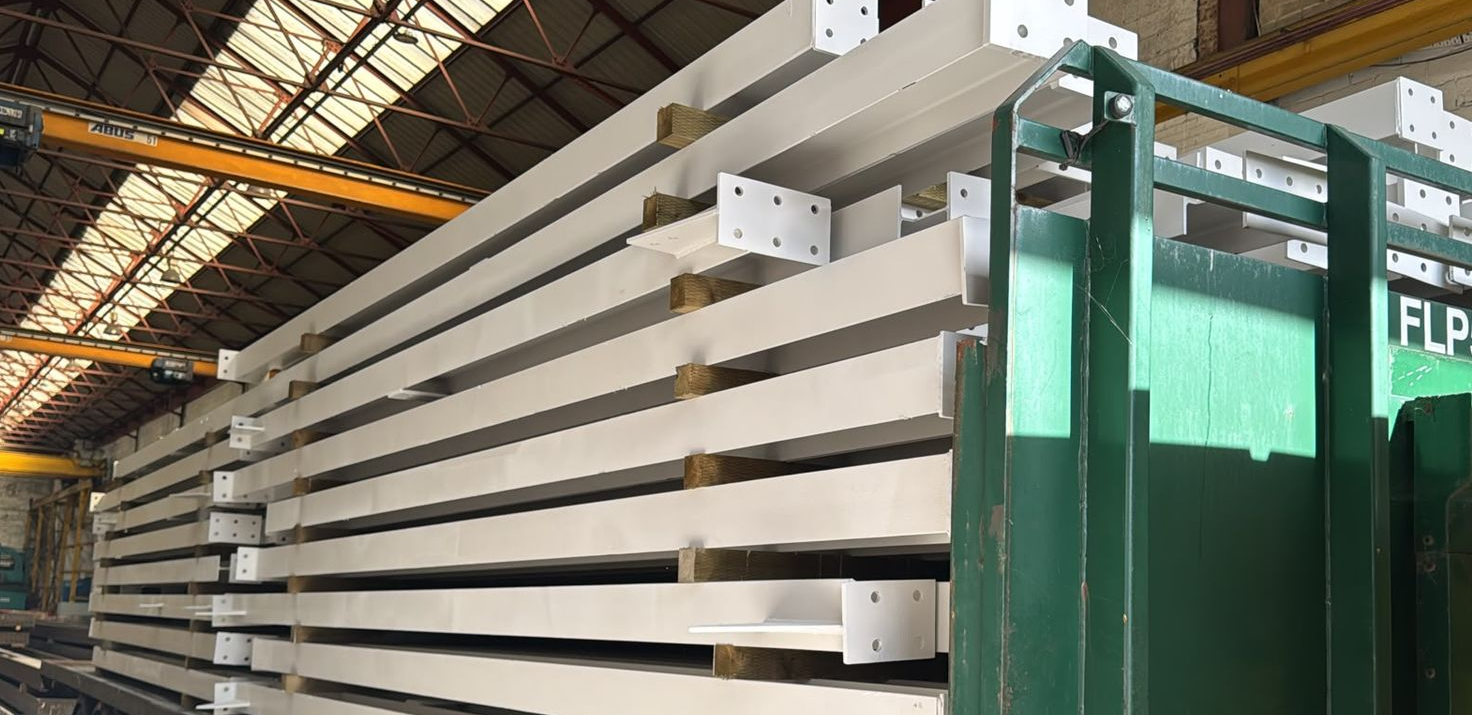
Store the beam securely if it is not going straight in: If the beam cannot be installed on delivery day, store it flat on timber bearers clear of the ground, in a position where it will not be walked on, driven over or knocked by plant. Steel stored directly on damp ground will begin to re-rust quickly, particularly on a shot-blasted surface without a protective coating.
Site preparation checklist
Use this checklist in the days before your steel delivery.
- Delivery address, postcode and access restrictions confirmed with fabricator
- Delivery week and preferred day agreed
- Vehicle access route checked for width, height restrictions and turning space
- Parked vehicles cleared from unloading area on delivery day
- Landing area cleared and ground condition checked
- Scaffold boards or matting laid if ground is soft or recently disturbed
- Lifting equipment identified and on site
- Internal route measured against beam length and every obstruction checked
- Doors, frames and skirting removed where needed
- Temporary propping in place and loaded per engineer's layout
- Pocket or chase cut to correct dimensions
- Padstones installed and cured
- Bearing heights checked and levelled
- Competent person confirmed to be on site for deliver
Getting your steel order right from the start
Good site preparation starts with a good order. When you place your order with us, give us as much information as possible about the site, the access, the programme and any constraints that might affect delivery. We fabricate all of our steel in-house at our Wakefield workshop and we are happy to talk through delivery logistics as part of the quoting process.
To place an order or discuss an upcoming project, call us on
07301 033 581 or send your drawings to
contact@buildersbeamsrus.co.uk.
Related Services:
Related Reading: